Sheet M-09 · Market
Branding Agency in Hyderabad
A brand is a system, not a logo file. We build identity systems that survive contact with the real world — the printer in Secunderabad, the signage fabricator, the social media intern, the hoarding vendor — so your business looks like one deliberate institution at every touchpoint. That covers strategy, naming, visual identity, collateral and guidelines, with specific depth in hospital and clinic environments where signage, wayfinding and print carry real operational weight.
Sheet M-09 · Contents
1.1 · The Problem
A Logo File Is Not a Brand System
Most local businesses bought a logo once and have been improvising ever since. Without a system behind the mark, every new touchpoint is a fresh interpretation — and the accumulated inconsistency quietly costs trust, especially in sectors like healthcare where visual coherence signals institutional competence.
- 01A logo designed in isolation, with no typography, colour or layout system behind it — so every new brochure, ad and hoarding is improvised from scratch
- 02Different vendors — printer, signage fabricator, social media designer — each producing their own interpretation until the brand looks different at every touchpoint
- 03Hospitals and clinics where signage, wayfinding, prescription pads and reception material carry two or three versions of the identity, eroding the trust the institution depends on
- 04Names chosen without trademark screening or domain checks, discovered to be unregistrable or already contested after the boards are printed
- 05Rebrands attempted as a logo swap with no rollout plan for signage, stationery, listings and digital assets — leaving the old identity alive in half the places customers look
1.2 · Our Framework
Identity System Framework
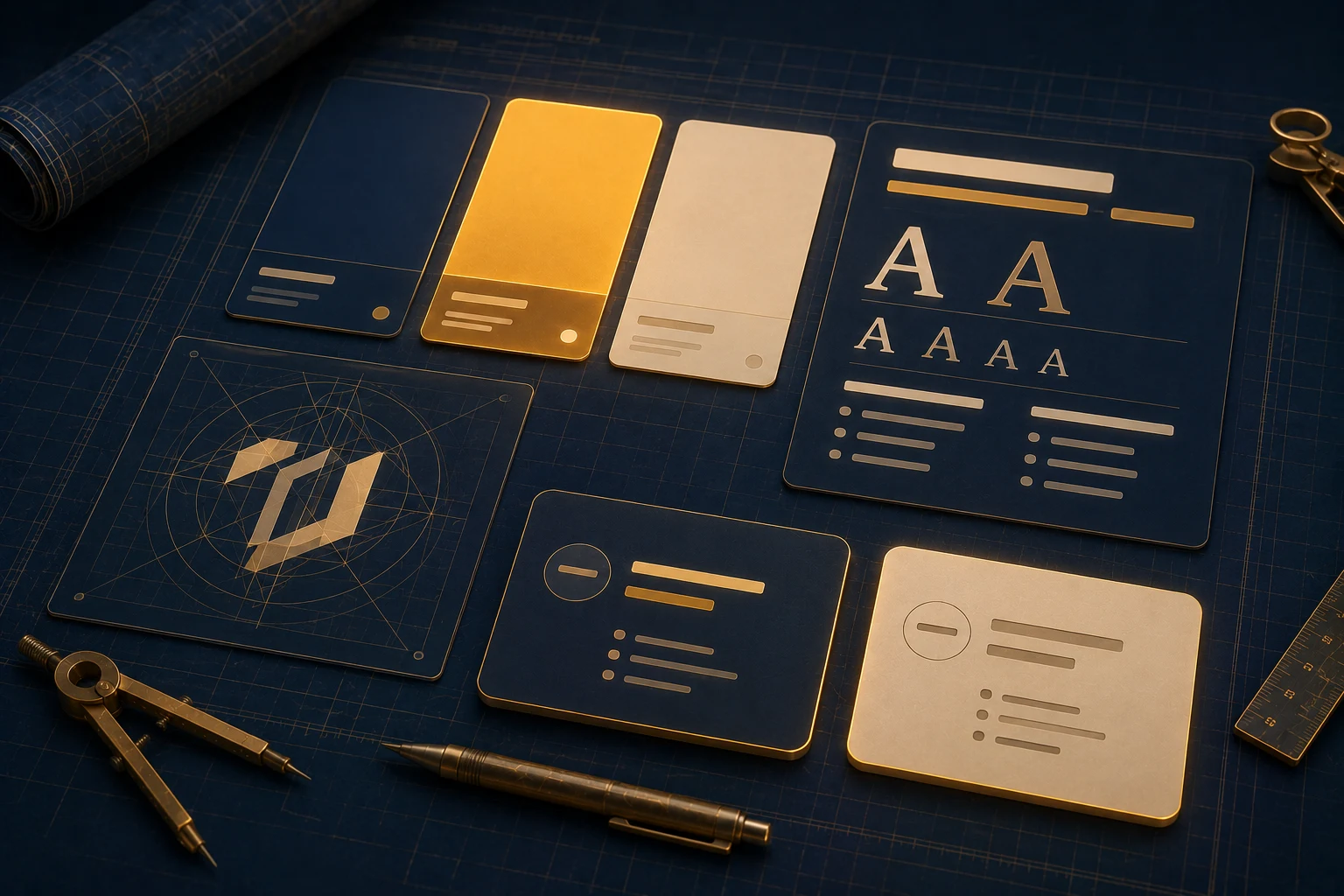
We treat identity as engineering: a defined strategy, a screened name, a visual system with rules, applications specified for real-world production, and guidelines that transfer the system to anyone who touches it after us.
Brand Strategy & Positioning
Before anything visual, we define what the brand must communicate and to whom: positioning against named local competitors, audience segments, and the two or three attributes every touchpoint must reinforce. For a hospital that might be clinical authority and warmth; for a D2C brand, distinctiveness on a crowded shelf and feed.
Naming & Verbal Identity
Structured naming for new ventures, sub-brands and service lines — generated against criteria, then screened for trademark-class conflicts, domain and social-handle availability, and pronunciation across Telugu, Kannada, Hindi and English speakers before you commit. Tagline, tone of voice and messaging hierarchy complete the verbal layer.
Visual Identity System
The full mark suite — primary logo, monogram, lockups — plus typography, colour with print and digital values, grid, iconography and photographic direction. Every element is specified with rules for use, so the system produces consistent output regardless of who is applying it.
Applications & Environment
The system applied to the touchpoints your business actually uses: business stationery, brochures, pitch decks, packaging, vehicle graphics, uniforms, digital templates — and for healthcare, the environment layer: facade signage, department wayfinding, room and floor identification designed to be legible under stress and consistent with the identity.
Guidelines & Governance
A working guidelines document with logo rules, colour values in CMYK, Pantone, RGB and hex, typography and layout specifications, and correct-versus-incorrect examples — plus organised, production-ready file packages for print and digital vendors. The system is only real if the next vendor can execute it without us in the room.
2.1 · Our Process
From Brief to a Brand That Ships Consistently
| Stage | Phase | Detail |
|---|---|---|
| 01 | Discovery & Audit | Stakeholder interviews, audit of every existing brand touchpoint, and review of direct competitors in your category and area. For rebrands, we document which equity elements — name recognition, colour association, signage familiarity — must be retained versus retired. |
| 02 | Strategy & Positioning | A written brand strategy covering positioning, audience, personality and messaging hierarchy, agreed and signed off before design begins. This document becomes the test every later design decision must pass, which is what keeps the process objective instead of taste-driven. |
| 03 | Naming & Concept Directions | Where naming is in scope: shortlist generation, trademark and domain screening, and language checks before presentation. Then two to three distinct identity concept directions, each shown applied to your real touchpoints — a signboard, a brochure, an Instagram grid — rather than as an isolated mark on a white slide. |
| 04 | Identity System Development | The selected direction is developed into the complete system: refined mark suite, typography and colour specification, layout grids, iconography and photography direction, with structured revision rounds against the strategy document. |
| 05 | Collateral & Environment Design | Design of the agreed application set — stationery, brochures, packaging, digital templates, and for hospitals and clinics, signage and wayfinding drawings prepared with materials and dimensions specified for fabricators. Print items are specified for how Indian print vendors actually work, down to the file formats they ask for. |
| 06 | Guidelines, Handover & Rollout | Delivery of the guidelines document and organised asset library, plus a sequenced rollout map for rebrands: which assets change in what order, updates to Google Business Profile and directory listings, and vendor coordination so the old identity is fully retired rather than lingering alongside the new one. |
3.1 · Technology Stack
Built With Industry-Leading Tools
We leverage proven, scalable technologies to deliver enterprise-grade results.
- Adobe Illustrator
- Adobe InDesign
- Adobe Photoshop
- Adobe After Effects
- Figma
- CorelDRAW
- Pantone Matching System
- Google Fonts
- Fontshare
- Frontify
4.1 · Expected Outcomes
Measurable Results, Not Promises
Real metrics from real client engagements, demonstrating the impact of our engineering approach.
One System Across Every Touchpoint
The engagement is engineered so the hoarding on the highway, the prescription pad, the Instagram grid and the reception signage all derive from the same specified system — same marks, same colour values, same typographic rules — instead of separate vendor interpretations.
Guidelines Your Printer Can Actually Follow
Deliverables include CMYK and Pantone values, clear-space and minimum-size rules, and production-ready file packages in the formats print and signage vendors in Hyderabad actually request — so consistency survives after our involvement ends.
Names Screened Before the Boards Are Printed
Naming work includes trademark-class conflict screening, domain and social-handle checks, and multilingual pronunciation review before you commit — closing off the expensive failure mode of discovering a conflict after signage, packaging and registrations are done.
Rebrands With a Sequenced Rollout Map
Rebrand programmes ship with an ordered changeover plan — signage, stationery, listings, Google Business Profile, digital assets — with equity elements deliberately retained, so recognition built over years transfers to the new identity instead of being discarded with it.
5.1 · FAQ
Branding & Identity Questions
Answers to the questions we hear most from prospective clients.
What does a branding project cost?
A complete identity system for a startup or single-location business — strategy, logo suite, typography, colour, core collateral and guidelines — typically ranges from ₹75,000 to ₹2,50,000 depending on the depth of applications. Full hospital or multi-location identity programmes including signage and wayfinding specification run from ₹3,00,000 upward. Naming and rebrand programmes are scoped separately. We fix scope and price before starting, and the deliverables list is written into the agreement so there is no ambiguity about what a 'complete brand' includes.
How long does an identity project take?
A standard identity system takes four to eight weeks from kickoff to guidelines handover, depending on the number of applications and revision rounds. Naming adds one to two weeks upfront for generation and screening. Full rebrand rollouts run longer — eight to sixteen weeks — because the changeover sequence across signage fabrication, print runs and listing updates has its own physical timeline. We publish the schedule at kickoff with your review points marked, and delays on our side are ours to absorb, not yours.
Do you handle trademark registration?
We handle the screening layer — searching the Indian trademark registry for conflicts in your relevant classes, checking domain and handle availability, and flagging names that are descriptive or generic enough to be weak registrations. The filing itself is legal work, and we hand you over to an IP attorney with a clean brief: shortlisted name, classes to file in, and the search evidence. What we prevent is the common and expensive sequence of designing, printing and launching around a name that was never registrable.
Will a rebrand lose the recognition we have already built?
Only if it is done as a clean-slate exercise, which is rarely the right call for an established local business. During discovery we identify which equity elements carry your recognition — often a colour, a symbol, or simply the name itself — and the new system deliberately retains them while fixing what is broken. The rollout map then updates every place customers encounter you, including Google Business Profile, directories and review platforms, in a controlled sequence. Done this way, a rebrand reads to your market as the same trusted business, upgraded — not as an unfamiliar new one.
Get Started
Ready to transform your Branding & Identity?
Book a free 30-minute strategy call. We will audit your current setup, identify the highest-impact opportunities, and map out a clear path to measurable results.