

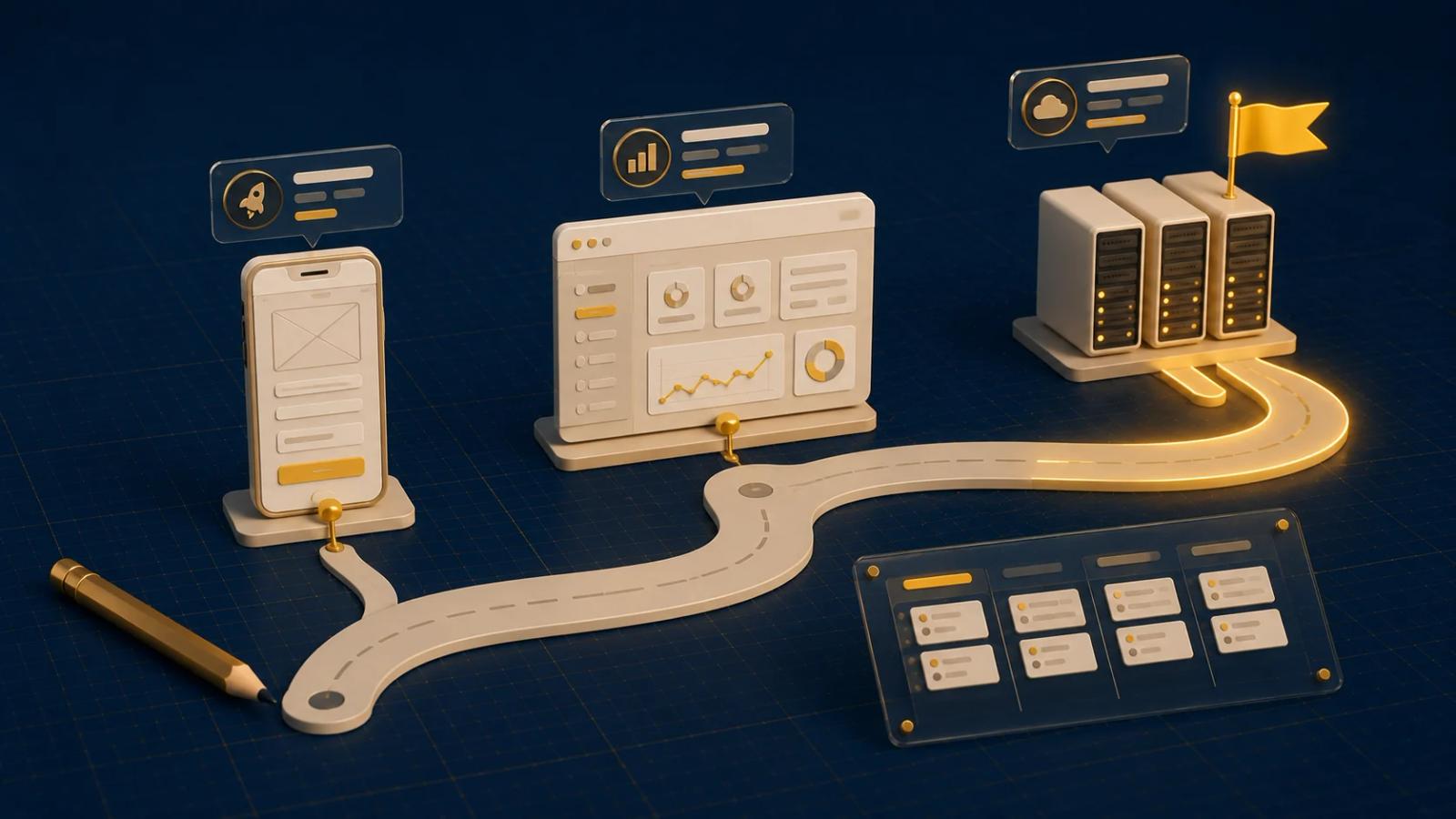
India's SaaS ecosystem generated over $14 billion in revenue in 2024, with Bengaluru-based companies accounting for roughly 40% of that figure. Yet for every Freshworks or Zoho, hundreds of SaaS startups fail — not because of bad ideas, but because of poor architectural decisions made in the first six months.
This roadmap documents the critical technical and strategic milestones from initial MVP through sustainable scale.
Phase 1: Validated MVP (Month 1-3)
The goal is not to build a product. The goal is to build the minimum system required to validate that paying customers exist.
Technology Decisions That Matter
Choose a monolithic architecture for your MVP. Microservices at this stage are premature optimization that will slow you down by 3-5x. Next.js with a Node.js API layer and PostgreSQL handles 95% of B2B SaaS requirements at the MVP stage. Deploy on Vercel or Railway for zero-DevOps overhead.
What to Build
Core value proposition functionality — the one thing that solves the one problem for the one customer segment you are targeting. Authentication, basic role management, the core workflow, and a billing integration with Razorpay or Stripe. Nothing else. Every feature beyond this is a hypothesis you have not validated.
Validation Metrics
Your MVP is validated when you have at least 10 paying customers (not free users), a net promoter score above 30, and at least 3 customers who would be "very disappointed" if the product ceased to exist.
Phase 2: Product-Market Fit (Month 3-9)
With validation confirmed, the focus shifts to finding the repeatable acquisition and retention patterns.
Infrastructure Upgrades
Implement proper observability — application monitoring with tools like Sentry, infrastructure monitoring, and structured logging. Set up a CI/CD pipeline that enables multiple daily deployments with confidence. Introduce automated testing for critical user flows.
Growth Engineering
Build the instrumentation layer: event tracking for every meaningful user action, cohort analysis capabilities, and funnel visualization. You cannot optimize what you are not measuring. Implement product-led growth mechanics: in-app onboarding flows, feature discovery prompts, and usage-based upgrade triggers.
Pricing Architecture
Indian SaaS companies consistently underprice their products. If enterprise customers are not telling you the price is reasonable, you are leaving money on the table. Implement tiered pricing with a self-serve tier for SMBs and a sales-assisted tier for enterprises. Usage-based components (seats, API calls, storage) create natural expansion revenue.
Phase 3: Scaling Infrastructure (Month 9-18)
This phase is triggered by specific signals: response times exceeding 200ms at peak load, deployment frequency being limited by architectural coupling, or team size exceeding 8 engineers.
Architecture Evolution
Begin extracting high-load or independently-scaling components into services. Common first extractions: notification service, file processing, search indexing, and analytics pipeline. Implement a message queue (Redis or RabbitMQ) for asynchronous processing. Move to containerized deployments with Kubernetes when operational complexity justifies it.
Data Infrastructure
Separate your transactional database from your analytics workload. Implement a data warehouse (BigQuery or Redshift) fed by change data capture from your primary database. This enables complex reporting and ML model training without impacting production performance.
Phase 4: Market Expansion (Month 18+)
With a stable, scalable product and proven unit economics, the architecture must now support geographic expansion, enterprise features (SSO, audit logs, custom SLAs), and platform capabilities (APIs, webhooks, marketplace).
The companies that reach this phase are the ones that made disciplined architectural decisions in Phase 1, validated ruthlessly in Phase 2, and invested in infrastructure before it became an emergency in Phase 3.