

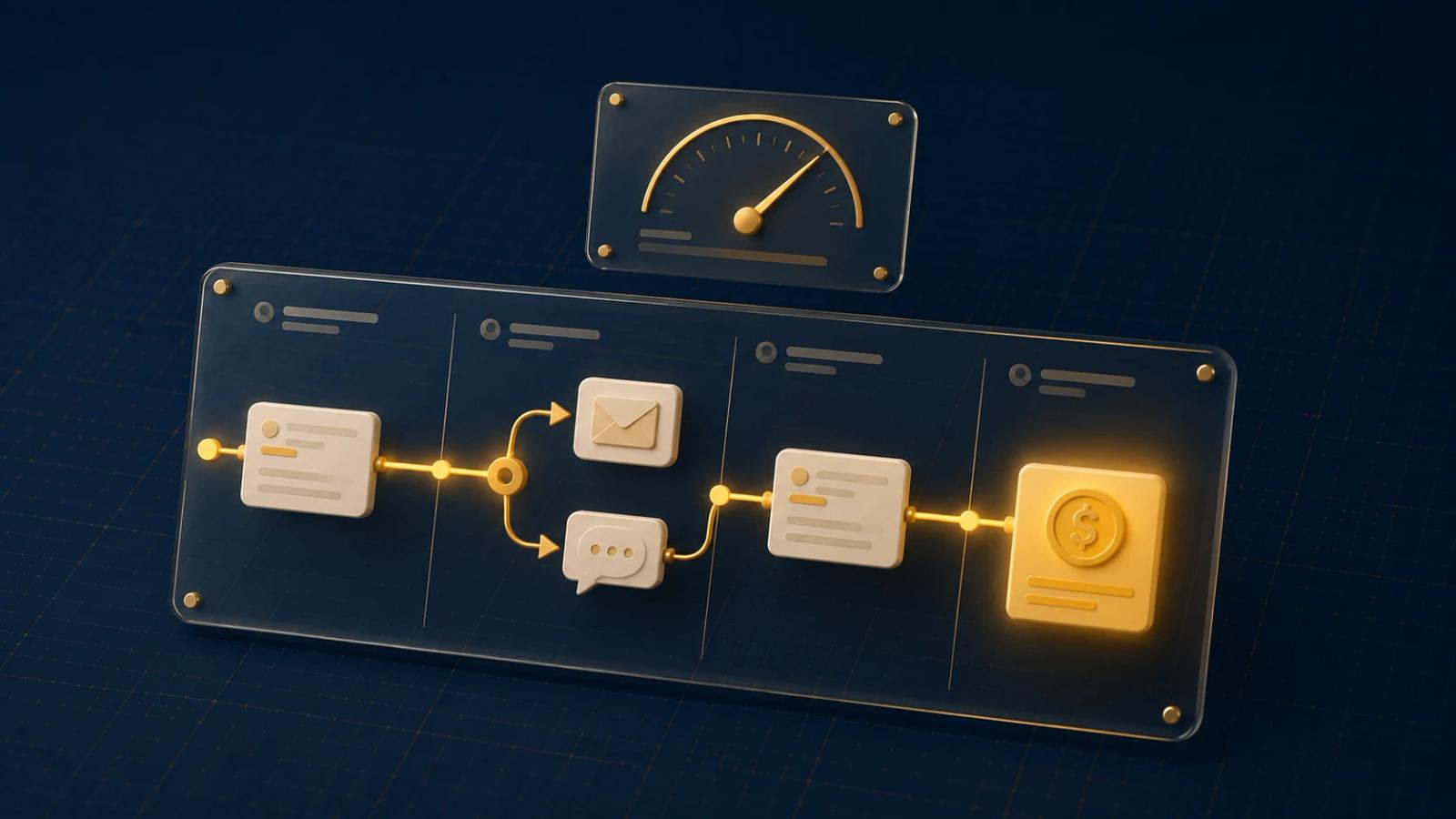
The average Indian company uses less than 18% of their CRM's capabilities. They are paying for a revenue engine and using it as a Rolodex.
CRM automation is not about technology adoption — it is about engineering systematic revenue processes that operate independently of individual salespeople's discipline, memory, or bandwidth.
The Revenue Automation Stack
Lead Scoring & Prioritization
Not every lead deserves equal attention. Behavioral lead scoring assigns numerical values based on actions — website visits, content downloads, email engagement, pricing page views — combined with demographic fit scoring based on company size, industry, and role. The result is a prioritized queue that directs your sales team's finite attention toward the highest-probability opportunities.
In our implementations, lead scoring alone typically improves sales team efficiency by 30-40% by eliminating time spent on unqualified leads.
Multi-Channel Nurturing Sequences
The average B2B buyer in India requires 8-12 touchpoints before making a purchase decision. Manual follow-up at this scale is impossible. Automated nurturing sequences deliver the right message through the right channel — email, WhatsApp, SMS, or retargeting — based on where the prospect sits in the decision journey and how they have engaged previously.
Sales Handoff Automation
The transition from marketing-qualified lead to sales-accepted lead is where most Indian companies lose 20-30% of their pipeline. Automated handoff protocols ensure instant notification, context transfer, and follow-up deadlines. If a sales rep does not engage within the defined SLA, the lead automatically escalates or reassigns.
Post-Sale Lifecycle Automation
Revenue does not end at the first transaction. Onboarding sequences reduce time-to-value and prevent early churn. Usage-based triggers surface upsell and cross-sell opportunities at the moment of highest receptivity. Renewal automation begins the re-engagement process months before contract expiry.
Platform Selection for Indian Companies
The Indian market presents unique considerations for CRM selection:
HubSpot excels for companies in the ₹1-50 crore revenue range with its unified marketing, sales, and service hub. Its pricing scales with contacts, making it cost-effective for companies with focused targeting.
Salesforce remains the enterprise standard for companies above ₹50 crore or those requiring complex multi-object data models, advanced reporting, and extensive third-party integrations.
Leadsquared has emerged as a strong contender for Indian companies, particularly in healthcare, education, and financial services, with built-in WhatsApp integration and India-specific compliance features.
Zoho CRM offers compelling value for cost-conscious companies, with a comprehensive suite and data residency in India.
Implementation That Actually Works
The number one reason CRM automation projects fail in India is not technology — it is change management. The system must be designed around how your team actually works, not how the CRM vendor thinks they should work.
Our implementation framework starts with process mapping: documenting every step of the current sales and marketing workflow, identifying bottlenecks and manual steps, and then engineering automation that eliminates friction rather than adding complexity.
Every automation we build must pass a simple test: does this directly contribute to generating, accelerating, or retaining revenue? If the answer is not an immediate yes, it does not belong in the system.